


Metal, Plastic, Silicone spoons – Help Me Choose

Kitchen spoon or ladles are an absolute essential in the kitchen. Most of us have solid ones and slotted ones.
The problem comes when we mix up different materials.
We may have a solid stainless steel spoon and wooden one, but then we also have a stainless steel slotted spoon and a plastic or rubber version.
The materials used can make a big difference to how well we cook our foods, and how well we present our foods.
Understanding which material works best for which task makes a massive difference to how your food will look when dished up.
Here’s our guide to buying kitchen spoons. Read on, and you will never have to worry about melted utensils, or ruined food, ever again!
Stainless steel
This is used in many food utensils as it is corrosion free and does not react with foods. It can also handle high temperatures and is a very robust material that can last a lifetime.
This makes it ideal for use in cooking, and it is why many pans, cooking utensils and eating utensils, such as forks and spoons, are made with stainless steel.

However, it's this robustness that is its undoing when it comes to stainless steel spoons. Many of us now have nonstick pans, coated with enamel, Teflon, or other coating.
Stainless steel will scratch off this coating and damage your nonstick pans. Stainless steel can also damage glass or Pyrex dishes.
The other problem is that stainless steel conducts heat.
The heat from the base can travel up to the handle, and into your hands!
Wooden spoons
Many recipes calls for a wooden spoon to be used. The reason why is because some recipes have a high acidic content (e.g. vinegar, lemon curd, tomato or BBQ sauce etc).
When metal spoons are used, the metals can react with the acidic ingredients, leaving a nasty metallic taste, or even discoloring your food.
Wood is a non-reactive substance, so will not do this to acidic foods. It’s also got a high heat tolerance, so it will not melt or damage if you leave it resting on the side of a hot pan.

The downsides are that, although not as damaging as stainless steel spoons, they can rub off the nonstick coatings of pans. It’s also much more difficult to scrape pans as wood is soft and ‘blunt’.
Plus, wood is a natural porous substance, which means that, over time, it will absorb food juices and odors.
Plastic spoons
They can melt!
However, most manufacturers have countered this by creating rubber or plastic spoons that have a high melting point.
So, unless you are literally using them on open fire, then you should be OK.
However, these spoons tend to be some of the cheapest on the market, and for good reason too. They tend not to last very long, and will fall apart and fail if used on a daily basis.
Plastic or rubber spoons are a good choice for the occasional cook.
For anyone that cooks more often, the money you'll save from buying these will be completely obliterated by having to replace these types of spoons within a year.

Silicone spoons
There has been a lot of silicone-based kitchen goods turn up over the last decade or so. And they really do seem to be the answer.
Silicone spoons are soft, so they don't rub off nonstick coatings on pans, they are insulated, so less transference of heat, and they are non-porous, so they don't absorb food juices and odors.
The real issue with silicone is the fact that this material has only been used widely in food utensils for a few years.
There is not enough data to be 100% sure of health safety. This is by no means a scare tactic!
There's a very good chance that silicone is completely safe. It's just that enough time has not passed to be absolutely sure.
Here at Chef Remi, although we do use silicone in some of our products, we prefer to use them in utensils that will not be used on high heat.
Also, many people comment that their silicone utensils have a certain odor. Some state that this odor leaves after a few uses, but some say it stays and never leaves.
Food Grade Nylon spoons
Nylon can handle high temperatures (our 3 Piece Kitchen Spoon Set is heat resistant up to 410°F), and is soft so won't scratch nonstick coatings on pans.
It's also non porous, so does not absorb food juices and odors, is hard wearing, does not react to acidic ingredients, will last many years without falling apart and, crucially, has been used in kitchen utensils for decades, so has a long history of safety.
Does this mean you should only choose food grade nylon?
It's up to you.
Wooden spoons do look great in the kitchen, and can impart a ‘rustic’ feel that many love. Stainless steel spoons can be safely used on metal pots and pans, so if you mainly use those, you’ll have no issues
But for everyday use in the kitchen, you'll be hard pressed to find a better, safer material than nylon.
Our Ultimate choice of material for our Spoon Set
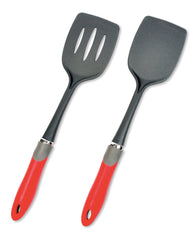
We recommend, for daily usage, opting for food-grade nylon. It is our choice of material for the newest addition to the growing Chef Remi collection. Below is a picture submitted by one of our early customers raving about the product.

The Chef Remi Spoon Set comes with 14-inch long solid and slotted spoons in ergonomic soft handles. They are lightweight but heavy duty kitchen utensils.
Guaranteed safe for all your bakeware and cookware, these spoons will never leave scratches on your sauce pans.
The set comes with a free silicone spoon rest so you never have dirty countertops. They are space saving and dishwasher safe.
The Spoon set is available for only $10.00 but you can get a further 15% OFF your entire order today! (Limited Offer). Click the link below to claim your discount.


Comments
Lily Lupin#1
This is such a good article! I was always told by my grandmother that I should not use metal spoons when using aluminium pots as I could get metal poisoning (!) She may have been exagerrating a bit, but I always thought that wooden spoons make the food taste better. Maybe just a personal preference.
Norma Louis#2
Love this article, I love how it explains the differences and outlines the pros and cons. Being a self taught cook i wish i would have had this information sooner and not had to burn through many many plastic spoons before i realized there were better tools for the job. I personally love wooden and silicone best and i absolutely beleive that using wooden makes the food have a different flavor than the silicone but it may be all in my head :)
theskies#3
I absolutely hate using metal spoons! I didn’t like the scratching sounds on my pans when I scraped food out :(, I never tried nylon before, sounds like a better alternative :o